Are you ready to make July your most intentional month yet? Whether you’re journaling to spark self-growth, boost your productivity, or just reconnect with yourself, these daily prompts will guide you through a month of powerful reflection.
This month-long journaling journey is designed to help you:
- Strengthen your growth mindset
- Reflect on your habits and productivity
- Get clarity on your goals
- Build more intentional self-awareness
Why Journal Daily in July?
July is the perfect mid-year checkpoint. Nestled right in the middle of the calendar year, it marks a natural pause—a moment to catch your breath and take stock of how far you’ve come. The rush of January goals has faded, and the year’s rhythm has likely settled into something steady, or maybe even a little stagnant. July offers the rare chance to step outside the day-to-day grind and ask the big, important questions: What’s working? What’s not? What needs to change?
This is a powerful time to re-align with your values, re-evaluate your goals, and recommit to what truly matters—before the rest of the year slips away. Whether you’re seeking growth, balance, or simply clarity, carving out time for reflection can change everything.
That’s where daily journaling comes in. A journal isn’t just a blank page—it’s a consistent, intentional space where you can reconnect with yourself. Each entry is a small act of mindfulness, a way to reset your perspective and redirect your energy toward the version of you that you want to become. Whether you’re celebrating wins, acknowledging challenges, or setting fresh intentions, journaling in July helps you show up with purpose for the rest of the year.
All you need: a journal or digital notes app, 10–15 minutes daily, and an open mind.
Week 1: Awareness & Intention
Theme: Self-awareness is the foundation for growth.
Lasting growth—whether it’s personal, emotional, professional, or creative—doesn’t happen by accident. It begins with a conscious decision to know yourself more deeply. Self-awareness isn’t just about noticing your habits or naming your emotions; it’s about tuning in to the why behind your choices, the patterns behind your reactions, and the values behind your goals.
When you develop self-awareness, you start to catch yourself in the moments that matter most. You notice when you’re falling into old routines that no longer serve you. You recognize the limiting beliefs that keep you small, and you begin to hear the quiet voice of your intuition guiding you toward something better. That’s when real change becomes possible—because you’re no longer operating on autopilot. You’re moving with intention.
The more honest you are with yourself, the more clearly you’ll see the gap between where you are and where you want to be. That clarity, while sometimes uncomfortable, is a gift. It gives you the power to take aligned action, to make adjustments, and to build the kind of life that actually feels like yours.
Growth without self-awareness is like building a house without a foundation—it might look good on the outside, but it won’t hold up over time. Self-awareness grounds you. It gives your growth direction, meaning, and depth.
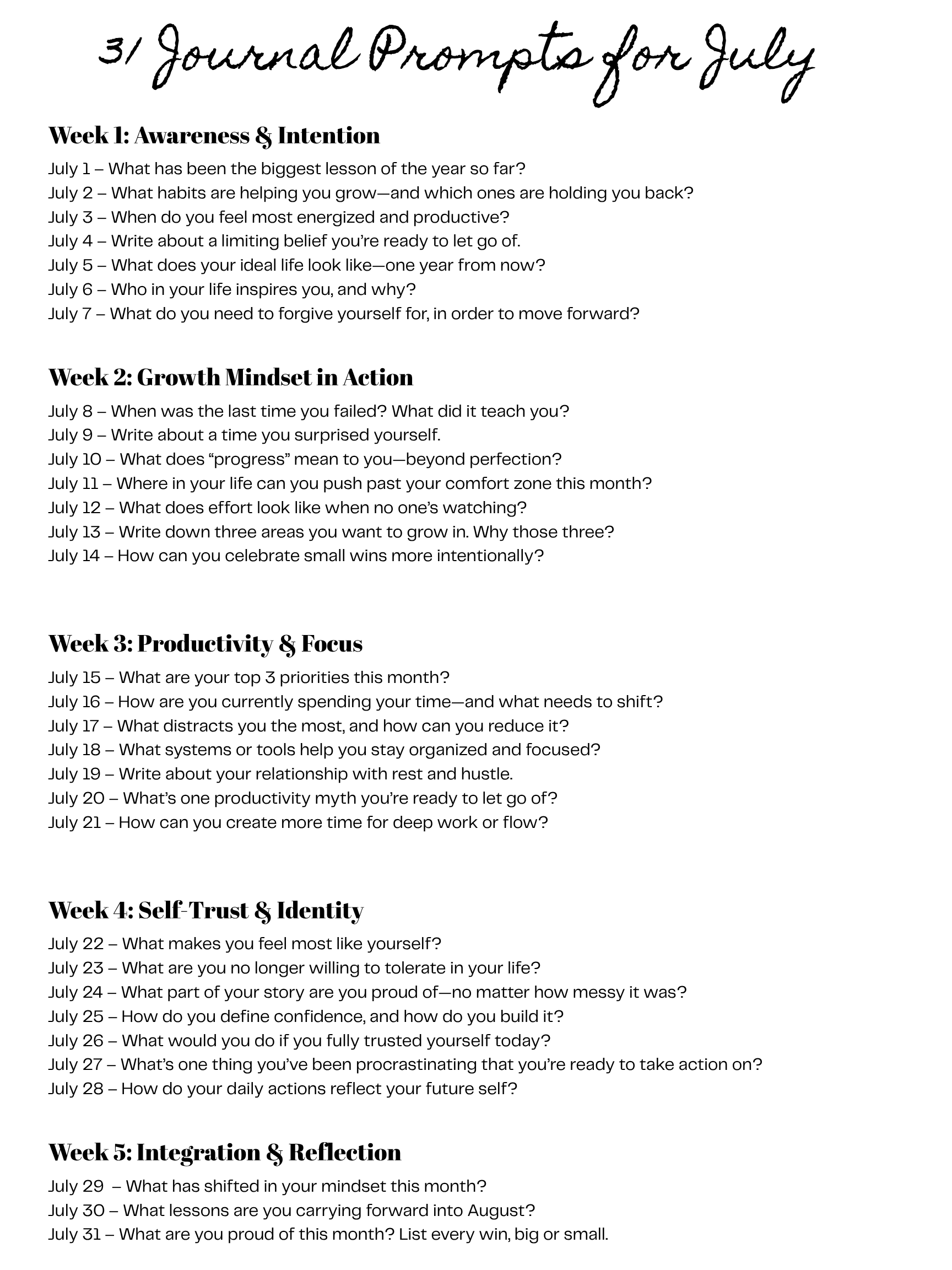
July 1 – What has been the biggest lesson of the year so far?
Reflect on the past 6 months. What did you learn about yourself, others, or the world?
July 2 – What habits are helping you grow—and which ones are holding you back?
Look at your daily routine honestly. What’s working? What needs adjusting?
July 3 – When do you feel most energized and productive?
Identify the time of day, environment, and activities that help you thrive.
July 4 – Write about a limiting belief you’re ready to let go of.
Is there a story you tell yourself that’s keeping you small?
July 5 – What does your ideal life look like—one year from now?
Get specific. Where are you? Who are you with? What are you doing daily?
July 6 – Who in your life inspires you, and why?
What traits do they have that you’d like to grow in yourself?
July 7 – What do you need to forgive yourself for, in order to move forward?
Forgiveness is powerful fuel for growth. Let yourself release it.
Week 2: Growth Mindset in Action
Theme: Embracing challenge, failure, and effort as stepping stones.
We’re often taught to avoid discomfort, to strive for ease, and to measure success by how effortless something appears. But real growth—the kind that shapes character, builds resilience, and unlocks new potential—comes through the exact opposite: challenge, failure, and effort.
Challenges aren’t roadblocks; they’re invitations to rise. They stretch your limits, teach you patience, and reveal your inner grit. Every time you meet a challenge with curiosity instead of fear, you build emotional muscle. You prove to yourself that you’re capable of more than you thought.
Failure, too, is often misunderstood. It’s not the end of the path—it’s part of it. Failure brings lessons no success ever could. It points out blind spots, strengthens humility, and helps refine your goals. If you let it, failure can become your most honest teacher, helping you learn faster, grow wiser, and pivot toward something more aligned.
Effort is where transformation really lives. In a world that glorifies shortcuts and quick wins, choosing to show up consistently—even when it’s hard—is radical. Effort means investing in the process, not just the outcome. It means being willing to take one more step, one more try, one more breath, even when it’s messy or uncertain.
Together, challenge, failure, and effort form a kind of personal training ground. They forge resilience, courage, and self-trust. When you embrace them not as signs of weakness or struggle but as essential stepping stones, you unlock a mindset that fuels long-term growth.
You stop asking, “Am I there yet?” and start asking, “What am I learning here?”
That shift is everything.
July 8 – When was the last time you failed? What did it teach you?
Instead of shame, look at it as feedback.
July 9 – Write about a time you surprised yourself.
When did you do something you thought you couldn’t?
July 10 – What does “progress” mean to you—beyond perfection?
Define what growth looks like without being tied to outcomes.
July 11 – Where in your life can you push past your comfort zone this month?
Growth never happens where it’s cozy.
July 12 – What does effort look like when no one’s watching?
How do you stay accountable when the results aren’t immediate?
July 13 – Write down three areas you want to grow in. Why those three?
Be specific about why they matter to you now.
July 14 – How can you celebrate small wins more intentionally?
Growth is a long road. Reward the micro-moments.
Week 3: Productivity & Focus
Theme: Aligning Your Time with Your Values
Time is one of our most limited—and most powerful—resources. Every hour spent is a quiet vote for the life you’re building. And yet, so often, our days slip by filled with tasks, distractions, and obligations that pull us in directions that don’t reflect what truly matters to us.
That’s why aligning your time with your values is so transformational. It means getting honest about what’s important to you—not just in theory, but in action. What do you care about deeply? What kind of life are you trying to create? Who do you want to be at the end of the day, the week, the year?
When your schedule reflects your values, you experience more clarity and less resentment. You feel purpose behind your routines, meaning in your effort, and peace in your priorities. You begin to recognize that saying “yes” to what matters often means saying “no” to things that don’t.
But alignment doesn’t always mean perfection. Life is messy. There will be seasons when survival takes priority over vision, and that’s okay. The goal isn’t to micromanage every moment—it’s to return, again and again, to what’s true for you. Even a few minutes of aligned action—calling a friend, journaling, getting outside, resting intentionally—can bring your life back into focus.
This theme is an invitation to slow down and reflect:
- Are you spending your time in a way that honors your values?
- Do your calendar and your commitments reflect your real priorities—or someone else’s?
- What might shift if you gave yourself permission to realign?
Small changes in how you spend your time can lead to powerful changes in how you feel. When your time and your values match, you stop just getting through your days—and start living them with intention.
July 15 – What are your top 3 priorities this month?
Filter your goals through what really matters.
July 16 – How are you currently spending your time—and what needs to shift?
Do a mini time audit. What’s taking up space without adding value?
July 17 – What distracts you the most, and how can you reduce it?
Get honest about digital or emotional clutter.
July 18 – What systems or tools help you stay organized and focused?
Notion? Trello? Post-it notes? Explore what works for you.
July 19 – Write about your relationship with rest and hustle.
Are you always “on”? Are you allowing enough recharge?
July 20 – What’s one productivity myth you’re ready to let go of?
Ex: “You have to wake up at 5am to be successful.”
July 21 – How can you create more time for deep work or flow?
What conditions do you need to focus fully?
Week 4: Self-Trust & Identity
Theme: Owning Your Story, Your Values, and Your Next Chapter
You are the author of your life—and no matter what has happened before this moment, you hold the pen now.
Owning your story means honoring every piece of your past: the triumphs and the regrets, the lessons and the losses, the moments that broke you open and the ones that built you back. It’s about refusing to hide the real parts of yourself in shame or silence. Your story is not a weakness—it’s your power. Everything you’ve been through has shaped your perspective, your strength, and your voice. When you own your story, you take back control of the narrative.
But it’s not just about where you’ve been. It’s also about what you stand for right now. Owning your values means getting clear on what matters most to you—not what you were taught to want, not what others expect, but what feels deeply true. Your values are the compass that guide your decisions, boundaries, and relationships. When you live in alignment with your values, your life starts to feel less like something you’re reacting to—and more like something you’re consciously creating.
And then comes the next chapter. The future isn’t something that just happens to you—it’s something you participate in. Owning your next chapter means asking yourself: What do I want now? What am I ready to release? What am I ready to build? It’s an act of courage to choose a new direction, to rewrite old patterns, and to believe you are worthy of more.
You don’t have to wait for a new year, a milestone, or a permission slip. This moment—right now—is enough.
You’re allowed to evolve.
You’re allowed to begin again.
You’re allowed to write a story that reflects the real you.
July 22 – What makes you feel most like yourself?
Explore hobbies, places, people, and values that align with the real you.
July 23 – What are you no longer willing to tolerate in your life?
This is your line-in-the-sand moment.
July 24 – What part of your story are you proud of—no matter how messy it was?
Turn your “past mistakes” into marks of resilience.
July 25 – How do you define confidence, and how do you build it?
It’s less about how you look, more about how you act.
July 26 – What would you do if you fully trusted yourself today?
Write from a place of boldness.
July 27 – What’s one thing you’ve been procrastinating that you’re ready to take action on?
Why are you waiting? What’s the next tiny step?
July 28 – How do your daily actions reflect your future self?
Are you acting like the version of you you’re becoming?
Week 5: Integration & Reflection
Theme: Looking Back, Looking Ahead
There’s something powerful about the pause between where you’ve been and where you’re going. It’s a liminal space—one foot in the past, one reaching toward the future—and it’s rich with clarity, insight, and opportunity.
Looking back isn’t about dwelling or regretting. It’s about witnessing. It’s a chance to honor how far you’ve come, what you’ve survived, and the lessons you’ve collected along the way. When you slow down to reflect, you begin to see patterns: what energized you, what drained you, what choices felt aligned, and what pulled you off course. You start to make sense of the narrative behind your year so far—not just what happened, but how you showed up through it all.
Reflection is how growth becomes visible. It’s easy to forget progress when you’re in the thick of life, but when you take time to look back, even small shifts can feel monumental. Maybe you set boundaries where you once stayed silent. Maybe you started over after something ended. Maybe you simply kept going when you didn’t feel ready. That matters.
Looking ahead is where intention lives. It’s where you get to ask: What do I want more of? What am I ready to leave behind? What does the next version of me need? It’s not about obsessing over outcomes or predicting the future—it’s about choosing your direction. When you look ahead with clarity and courage, you give yourself permission to grow on purpose.
This theme invites you to bridge the gap between past and future with intention. The goal isn’t to fix everything overnight—it’s to move forward with awareness and alignment. By honoring what was and choosing what could be, you give the rest of the year space to unfold with meaning.
July 29 – What has shifted in your mindset this month?
Review your old entries. Where have you softened, stretched, or surprised yourself?
July 30 – What lessons are you carrying forward into August?
Write a short “pep talk” to future you.
July 31 – What are you proud of this month? List every win, big or small.
Close the month with celebration and gratitude.
Tips for Journaling Success
- Consistency over perfection. Even a few lines matter.
- No judgment. Let your journal be your soft landing place.
- Pair with a ritual. Light a candle, sip tea, put on a playlist.
- Revisit your favorite prompts. You’ll uncover deeper insights over time.
Final Thoughts
ournaling is more than just writing—it’s a tool for transformation. It’s a space where thoughts take shape, emotions find release, and clarity begins to form. When life feels busy, noisy, or directionless, your journal becomes a quiet place to return to yourself. It’s not about perfection or productivity—it’s about honesty. Presence. Self-connection.
These July prompts are here to support exactly that. Mid-year is a powerful time to pause, reflect, and redirect with intention—to take a breath and ask yourself where you are, how you’re feeling, and where you want to go next. Whether you’re navigating personal growth, striving for better focus, or craving a sense of clarity and peace, journaling offers a pathway inward.
Think of your journal as a mirror, a map, and a safe container all at once. It reflects who you are right now. It helps chart a course toward who you want to become. And it holds your thoughts, struggles, ideas, and breakthroughs without judgment.
This month’s prompts are designed to gently guide you back to your center. To help you uncover what matters, let go of what doesn’t, and realign your days with your deeper values and intentions. You don’t need to write pages. You just need to show up—with your truth, your curiosity, and your willingness to grow.
Because the real magic of journaling isn’t in the ink—it’s in the transformation that happens when you make space to listen to yourself.